
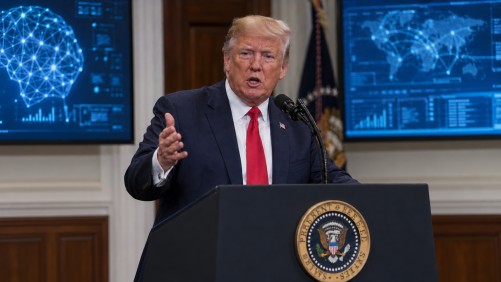
The proposed creation of an “AI Force” by former U.S. President Donald Trump could significantly influence the trajectory of artificial intelligence development in the United States, balancing innovation with safety. The initiative aims to monitor the rapidly evolving AI technology, a move that underscores the increasing necessity to address potential risks associated with advanced AI systems.
Trump’s plan, which includes appointing an AI czar, signals a heightened focus on maintaining U.S. leadership in AI, particularly against competitors like China. While details regarding the structure and timeline of the AI Force remain sparse, Trump likened its formation to that of the U.S. Space Force. His announcement highlights the growing debate on AI governance amid pressures from both technology leaders and global governments to ensure AI safety without stunting technological progress.
The former president has previously expressed resistance to stringent AI regulations, arguing they could impede American innovation and inadvertently benefit China. In a social media post, Trump described fears surrounding AI as exaggerated, suggesting that existing legal frameworks should suffice to handle any malpractices involving AI technologies. His stance reflects a broader policy discussion on how to balance economic competitiveness with the public’s safety.
This federal initiative follows California Governor Gavin Newsom’s recent announcement of a panel dedicated to AI safety regulations. Newsom’s approach includes exploring mechanisms to disable AI systems that deviate from their intended purposes. Moreover, the conversation around AI oversight is echoed by several Republican figures, including Florida Governor Ron DeSantis, who advocates for increased regulatory measures, and Utah Governor Spencer Cox, who calls for congressional action on AI safety and limiting technology transfers to China.
With AI poised to drive significant economic transformation, Trump’s proposal to establish an AI Force underscores the pressing need for a coherent strategy that ensures both the safe development of AI and the preservation of the U.S.’s competitive edge. As AI systems grow increasingly sophisticated and autonomous, the dialogue on managing their integration into society becomes ever more critical.