
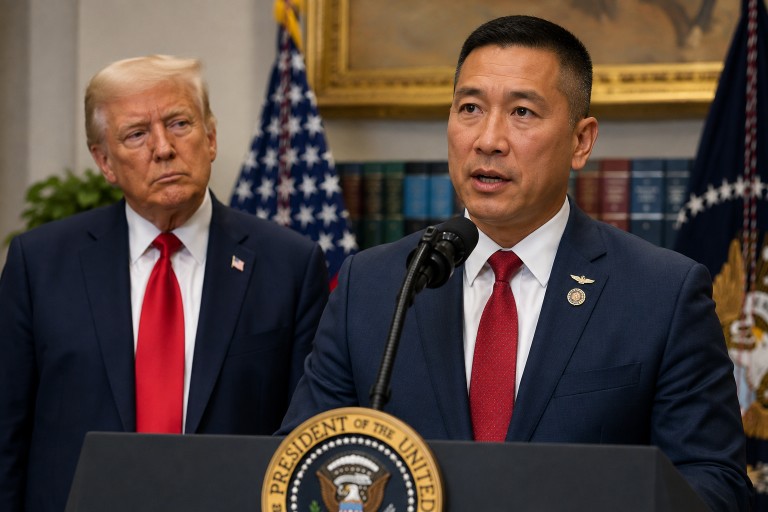
President Donald Trump has put forward Hung Cao, who is currently serving as acting Navy Secretary, as his choice for the permanent Secretary of the Navy. This nomination comes four months after the departure of former Secretary John Phelan and awaits Senate confirmation. Cao stepped into the role of acting secretary in April, following his tenure as the Navy’s undersecretary. His extensive military career spans 25 years, during which he served as a special operations officer with deployments to Iraq and Afghanistan, and as a diver and explosive ordnance disposal officer.
In announcing the nomination, Trump commended Cao as a “true warrior” and called for swift Senate confirmation. Cao expressed his gratitude for the nomination, emphasizing his commitment to enhancing shipbuilding initiatives and ensuring the security of the homeland. This nomination arrives at a time when the Navy is under intense scrutiny due to the challenges faced by its personnel amidst ongoing tensions with Iran. The extended deployment of the USS Abraham Lincoln has sparked legislative concerns about issues such as crew fatigue, mental health, and the adequacy of essential supplies.
During his period as acting secretary, Cao has prioritized shipbuilding, modernization, and the integration of artificial intelligence. His nomination coincides with wider shifts in the top echelons of U.S. military leadership, including the recent resignation of Army Secretary Dan Driscoll. These changes reflect a broader focus on expanding the capabilities of the U.S. armed forces, particularly the Navy, during a time of heightened operational demands.
Should Cao’s nomination be confirmed by the Senate, he will assume permanent leadership of the Navy and Marine Corps. This transition occurs as the Navy confronts significant operational challenges and seeks to bolster its strategic capabilities. The confirmation would mark a critical step in addressing the current and future demands placed on U.S. naval forces, ensuring they are well-equipped to meet national security objectives.